Young Voices Matter: What South Carolina’s Youth Are Telling Us About Homelessness

Lilly Simmons • September 28, 2026

When we talk about homelessness, it is easy to picture someone sleeping on the street or staying in an emergency shelter. But for many young people, homelessness looks very different.


It can mean sleeping on a friend’s couch. Staying temporarily with relatives. Moving from place to place. Sleeping in a car, a motel, or somewhere that was never meant to be a home.


That is one of the clearest messages from South Carolina’s 2026 Young Voices Matter Youth Homeless Count. The statewide effort brought together agencies, Continuums of Care, volunteers, community organizations, and young people across the state to better understand the experiences of youth who are unstably housed. More than 40 outreach events were held statewide, and 331 young people participated in the survey.


The result is more than a number. It is a clearer picture of what youth homelessness actually looks like in South Carolina.


Homelessness is often hidden


One of the most important findings is also one of the easiest to overlook: many young people experiencing homelessness are not sleeping on the street.


Thirty-two percent of surveyed youth reported that they most often slept at someone else’s apartment or house. Another 21% reported sleeping in a place not meant for human habitation. Others reported staying in transitional housing, emergency shelters, vehicles, motels or hotels, parks, abandoned buildings, or other locations.

This matters because traditional definitions and counting methods can miss young people whose homelessness is less visible.


A young person who is moving between friends’ homes may not consider themselves homeless. A young person who has a temporary place to sleep may not seek help. And someone who does not identify with the word “homeless” may never walk through the doors of a traditional homeless services provider.


The report specifically describes the initiative as an effort to identify hidden youth homelessness and create data that can inform funding, policy, youth housing design, and prevention efforts.


Young people are telling us what they need


When asked what services would be most helpful, housing was the most frequently identified priority.

Among the 185 young people who responded to the question, 43% identified housing as a top priority. Jobs, food, transportation, and shelter services were also among the most common responses.


That response is not surprising, but it is important to hear directly from young people themselves.

Safe, stable housing provides a foundation for everything else. It is much harder to focus on school, employment, health, or long-term goals when you do not know where you will sleep that night.


And young people were clear that housing is not the only issue. The report also identifies employment and economic stability, mental health, family conflict, and difficulty navigating systems and services as significant barriers.


This points to the need for responses that do more than provide a bed or a temporary place to stay. Young people need pathways to stability that connect housing with employment, education, transportation, mental health support, and other resources.


Youth homelessness affects communities across South Carolina


The survey reached young people across all four regions of the state. Of the 331 respondents, 55 reported sleeping most nights in the Upstate, 68 in the Midlands, 164 in the Lowcountry, and 31 in the Pee Dee. Twelve respondents did not report a county in South Carolina.


The report also shows the scale of housing instability among younger students.


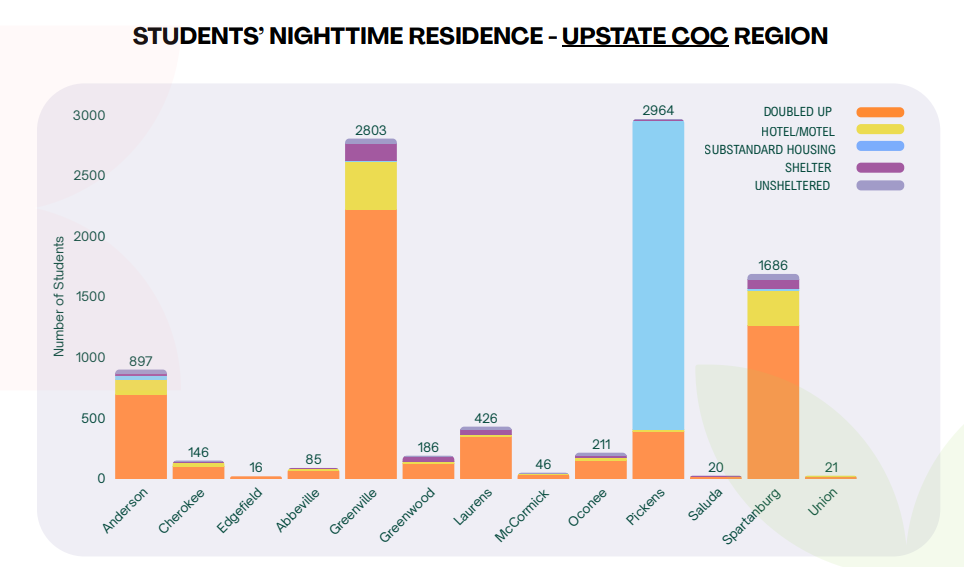
During the 2025-26 school year, 18,300 South Carolina students were identified as experiencing homelessness through the McKinney-Vento program. That program supports students experiencing homelessness by helping them remain enrolled in school, including through transportation and other services.


Importantly, McKinney-Vento uses a broader definition of homelessness that includes young people who lack a fixed, regular, and adequate nighttime residence because of housing loss, economic hardship, or similar circumstances.

The numbers show that youth homelessness is not confined to one community or one type of household. It is happening across South Carolina, often in ways that are difficult to see.

The data also tells us who is most affected

The young people surveyed were mostly between 18 and 21, with male and female respondents represented in nearly equal proportions. Among respondents who reported their race, 68% identified as Black or African American.


The McKinney-Vento data tell a similar story. Statewide, Black students made up a substantial portion of students identified as experiencing homelessness, with 9,406 Black students represented in the 2025-26 data.


Understanding who is experiencing homelessness is an important part of understanding where systems may be falling short and where additional support may be needed.


Listening has to be part of the solution


Perhaps the most important part of the Young Voices Matter initiative is not simply that young people were surveyed. It is how the campaign approached the process.


The initiative intentionally reframed the youth count as a statewide campaign rather than simply a data collection exercise. Organizers prioritized relationship-building and community engagement, used decentralized local leadership with centralized coordination, and brought outreach into places where young people already spend time, including recreation centers, small businesses, and churches. Volunteers and youth peers also helped expand outreach.


That approach matters because young people experiencing homelessness often avoid formal systems.

If we only look for young people in shelters, service offices, or other traditional settings, we are likely to miss many of the people we are trying to understand.

Instead, we have to go where young people are, build relationships, listen to what they are experiencing, and create systems that respond to what they tell us.


Young people are telling us where to start


The responses in this report are remarkably direct.


  • “Stability and a roof over my head.”
  • “A place to lay my head.”
  • “Housing for people who age out of foster care.”


These are not abstract policy concepts. They are young people describing the things they need to build stable lives.


The 2026 Young Voices Matter report allows South Carolina to listen differently. The data helps make hidden homelessness more visible, but the voices behind the data tell us why that visibility matters.


Youth homelessness cannot be addressed by one organization, one program, or one community. It requires collaboration across housing, education, employment, health, transportation, and other systems.


Most importantly, it requires listening to young people themselves.


Because if we want to build systems that work for young people, we have to make sure young people have a voice in building them.

VIEW THE FULL REPORT
By Lilly Simmons • October 2, 2026
Why Spartanburg needs an entry point off the street and into the housing continuum When someone experiencing homelessness is asked to move along from a public space, there is an important question that follows: “To where?” Right now, in Spartanburg, that question does not always have an answer. A Place to Call Home is working with the City of Spartanburg to change that by exploring the development of a low-barrier shelter. The goal is straightforward: create a safe place for people who have nowhere else to go, while connecting them with the support they need to move toward permanent housing. As Spartanburg Deputy City Manager Mitch Kennedy shared with The Post and Courier: “We need to be able to emphatically note, ‘Well, you can go here.’ Today, we can’t.” That simple statement captures a significant gap in our community's housing continuum. A low-barrier shelter would create an entry point for people who may have nowhere else to turn. Rather than requiring someone to overcome every barrier before they can access shelter, the approach starts with a safe place to stay and the opportunity to connect with case management and other supports. For APTCH, this is an important part of building a stronger pathway from homelessness to housing. A shelter is not the destination. It is a place to start. The Post and Courier recently took a closer look at the need for a low-barrier shelter in Spartanburg, what this model could look like in our community, and where this work stands today. Read the full story: https://www.postandcourier.com/spartanburg/news/spartanburg-new-homeless-shelter/article_468f4b93-ab2c-4cf6-865c-9dc7752a42d6.html
September 15, 2026
Discover how A Place to Call Home pairs Spartanburg landlords and tenants through the Welcome Home Network to prevent homelessness and create housing stability.
August 10, 2026
How We Got Here
August 3, 2026
Thousands of people experience homelessness throughout Spartanburg County over the course of a year, many of them within our city. However, most are never seen on a downtown bench or sidewalk. Many are living in cars, in motels, or couch surfing with a friend or family member. Some are single adults, but many are parents or children. The distance between what many people picture and what is actually happening is where this conversation begins. In this episode of the City Podcast, we sit down with Deputy City Manager Mitch Kennedy, A Place to Call Home Director Hannah Jarrett, and City Police Department’s Maj. Art Littlejohn to walk through the City's response to homelessness. The City's approach goes back nearly a decade, moving through the initial Homeless Taskforce that kickstarted the effort Spartanburg has today, a partnership that has created efforts like the Homeless Court, the HEART team’s dedicated street outreach, Workforce Heroes, and ultimately lead to the creation of A Place to Call Home, a countywide collective effort to prevent and reduce homelessness. The conversation also takes on the questions residents ask most often. Why does someone remain on the streets when help is available? What can a city require of an adult, and what can it only offer? When does a situation become a matter that requires police assistance or enforcement? Our conversation is candid about the limits, discussing gaps beyond the City's control and what it means to work collaboratively to address a systemic issue far larger than any one organization’s capacity. The centerline connecting it all is the balance the City must work to hold between the dignity and rights of people living unsheltered, the rights of property owners in our community, and ensuring that our public spaces remain accessible and work for everyone. Listen to the full podcast at the link below- https://www.cityofspartanburg.org/m/newsflash/home/detail/108
By Lilly Simmons • July 30, 2026
Understanding how stable housing strengthens health, opportunity, and the entire community.
June 23, 2026
Homelessness doesn't always look the way people expect. Many children and families experience "hidden homelessness" — living in motels, doubled up with relatives, or moving from place to place without stability. Because their struggles are less visible, their needs are often overlooked. Video: https://www.youtube.com/watch?v=j9QaBzm_Lc0 Before A Way Home opened its doors, there was no family shelter within 50 miles of Spartanburg. Families in crisis had nowhere local to turn, despite significant need across Spartanburg County: Approximately 3,000 people experience homelessness on any given night. An estimated 1,200–1,500 children experience homelessness in the county each year. 84% of single-mother households live below the ALICE Threshold . For children, housing instability means disrupted schooling, lost friendships, health challenges, and an erosion of the sense of safety every child deserves. A Way Home exists to address this need. Our Approach Three years ago, Spartanburg County had lost both of its family shelters. When community leaders presented a countywide plan to address housing and homelessness through A Place to Call Home, local congregations stepped forward to bring family shelter back. Today, 22 congregations maintain a rotational shelter that opens its doors to families each week. At night, families sleep, shower, and share meals in welcoming church spaces. During the day, they spend time at the Day Center, where they have access to laundry, case management, job resources, and transportation — and simply a place to be families and kids. Every Sunday, they move to a new host congregation, creating a network of care that extends far beyond any single building. A Place to Call Home staff provides individualized case management, helping families navigate housing applications, employment, benefits, and childcare. Participants meet weekly with their case manager to work toward their goals and stability. The program runs up to 90 days, with extensions based on progress. The goal is always permanent housing and long-term stability.Over the past year, one of our neighbors, who we will call James, moved into permanent housing after more than 20 years of living on the streets in downtown Spartanburg. He has now been stably housed since Thanksgiving. One Year of Impact 70 families resourced by A Way Home case managers 18 families sheltered with no other housing option 10 families in permanent, sustainable housing 500+ volunteers contributing over $360,000 in in-kind hours What those numbers look like in practice: “You reminded us that love is still alive and community still matters. You reminded us that faith is not only expressed through words but through action, patience and compassion. You showed us the heart of Christ in everything you did.” Those words came from a family who wrote to their host congregation after leaving the program — a reminder that the generosity of our partner churches leaves a lasting mark. One family arrived at A Way Home with nothing but the clothes on their backs. On their first night, they were welcomed by volunteers at the Unitarian Universalist Church of Spartanburg. Weeks later, when the rotation brought them back to the same congregation, the children ran ahead to greet the volunteers who had first made them feel safe. For those kids, it wasn’t just a shelter. It was a place where they were known and felt safe. The Partnership That Makes It Work A Way Home is not one organization doing this work alone. It is a collaboration. A Place to Call Home A Place to Call Home provides the professional backbone of the program. APTCH staff conduct family intakes, provide ongoing case management, and staff the Day Center Monday through Friday. They coordinate transportation, connect families to resources, and serve as the consistent thread of support throughout each family's stay. The Faith Initiative to End Child Poverty The Faith Initiative to End Child Poverty mobilizes Spartanburg's faith community to respond to child and family homelessness. The Faith Initiative recruits and coordinates partner churches, manages Sunday Day Center volunteers, and ensures that each week of hosting is covered and supported. Host Churches Host churches are the heartbeat of A Way Home. Each week, a congregation opens its space, preparing rooms, serving meals morning and evening, and providing overnight volunteers who ensure families are safe throughout the night. Hosting is a significant commitment, and the churches that step into this role do so with extraordinary generosity. Support Churches Support churches strengthen the work by providing additional volunteers, helping with meal preparation, and offering practical assistance to host congregations. This model means that churches of any size can participate in a meaningful way, because the entire network is stronger together. Every church in this network, whether hosting families for a full week or simply showing up to help serve a meal, is an essential part of why A Way Home works. A Way Home Churches: Bethel United Methodist Church Central United Methodist Church Church of the Nazarene Crossroads Baptist Church Fernwood Baptist Church First Presbyterian Church Grace Presbyterian Church Hub City Church Jesus Our Risen Savior New Beginnings United Methodist Church Second Presbyterian Church Silver Hill United Methodist Church St. James United Methodist Church St. John's Lutheran Church St. Margaret's Episcopal Church St. Matthew's Episcopal Church St. Paul the Apostle Catholic Church St. Paul United Methodist Church Trinity United Methodist Church Unitarian Universalist Church of Spartanburg Westminster Presbyterian Church Get Involved A Way Home runs because people choose to show up. Here are some ways you or your congregation can be part of this work: Volunteer at the Day Center Shifts are available on Sunday from 7 AM to 4:45 PM (broken into 3-hour slots) and on weekday afternoons. No special skills required, just a willingness to be present. A Way Home | A Place to Call Home | Spartanburg, SC Host or Support Families Congregations of any size can participate, whether by hosting families for a week or supporting a host church with meals and volunteers. Reach out to Sally Dyer at sbdyer@gmail.com to learn more about what's involved. Give Every contribution directly supports shelter, case management, and the resources families need to move toward permanent housing. Give online at ignite.stratuslive.com , or make a check out to United Way of the Piedmont with "APTCH – A Way Home" in the memo, mailed to P.O. Box 7300, Spartanburg, SC 29304. Donate in-kind items: twin-sized blankets, pillows, household cleaning supplies, and laundry detergent are always needed. Shop directly from the Amazon Wish List . To learn more or get connected, contact: · Deandra Comer, APTCH's Shelter and Housing Programs Manager, at dcomer@aptchspartanburg.org · Sally Dyer, Faith Initiative A Way Home Project Leader, at sbdyer@gmail.com Thank You A Way Home exists because of people who believe that every family deserves a safe place to land and who are willing to do the work of making that real. To our 500+ volunteers who contributed over $360,000 in in-kind volunteer hours: thank you. This impact belongs to all of you.
By Lilly Simmons • May 4, 2026
What One Year Made Possible.
May 4, 2026
"The solution is in the room with us"
By Lilly Simmons • January 22, 2026
Volunteers Come Together to Create Welcoming Spaces at Bridgeway Village
By Lilly Simmons • December 2, 2025
A Place to Call Home Honors Homelessness Awareness Month